Dr Dzulkifli calls for human-centred education and stronger academia-community links
Ian McIntyre
Dr urges universities to prioritise humanity, compassion and real-world engagement over rigid systems and profit-driven goals
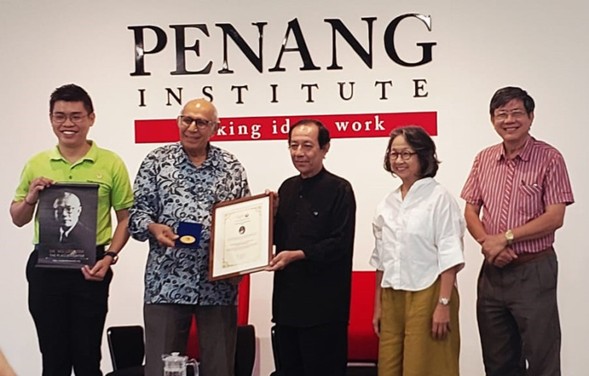
Academician emphasises that values cannot simply be taught in classrooms but must be developed through real-life exposure
FORMER Universiti Sains Malaysia vice-chancellor Tan Sri Dzulkifli Abdul Razak has called for a fundamental shift in Malaysia’s education system towards a more human-centred approach, stressing the need for stronger collaboration between universities and the communities they serve.
Speaking after receiving the Dr Wu Tien-Teh Award for Leadership in Public Health, he said institutions of higher learning must move beyond theoretical knowledge and engage more deeply with society.
“We also need to humanise education. Making our doctors or engineers human first and professionals second. We should advocate solving problems which can help humanity rather than just be obsessed with monetary gains,” he said.
He argued that while universities possess knowledge, communities offer lived experience and practical wisdom, making collaboration between the two essentials for meaningful progress.
Dzulkifli also emphasised that values cannot simply be taught in classrooms but must be developed through real-life exposure, urging greater integration between academic institutions and grassroots communities.
“We need to detox our education sector from the 3Ms of a fulfilling (manpower) requirement, rigid (mindsets) and (money) to the 3Hs of humanity, heart set and high touch of compassion and apathy,” he said.
He warned that the current system risks producing graduates disconnected from societal realities, adding that education should instead cultivate empathy and social responsibility to counter rising negative behaviours such as bullying.
Delivering his remarks at a public lecture in Penang, Dzulkifli also reflected on broader societal challenges, saying that education must evolve to address what he described as a growing “toxic culture” in the post-pandemic world.
“Education and communities must co-exist and we must act with one voice to resolve the issues gripping us,” he said.
He further urged policymakers and institutions to move away from what he termed a lingering “colonial mindset”, cautioning against overvaluing Western models while underestimating local capabilities.
“Education should be about enlightenment, not just memorising or passing examinations. It needs to be empowering; to invoke entrepreneurship,” he said.
Linking education to public health outcomes, Dzulkifli stressed that a healthy society begins with individual responsibility and awareness.
“If one cannot take care of oneself, hence the emergence of so many hospitals,” he said.
Quoting Mahatma Gandhi, he added that “the growing number of hospitals is the result of a decay in society”, arguing that increasing healthcare infrastructure may reflect declining public health standards.
He also called for a rethinking of the role of technology, suggesting that the current focus on artificial intelligence should be complemented by what he described as “Authentic Intelligence”, grounded in truth and integrity rather than manipulation.
In addition, Dzulkifli advocated stricter measures against vaping, describing it as harmful and addictive, and underscored the importance of preventive approaches in safeguarding public health.
The award he received is named after Wu Tien-Teh, a pioneering doctor known for combating plague outbreaks and developing an early form of the modern medical face mask, now widely recognised as a precursor to the N95 respirator. - April 19, 2026